Application Check
Automatically adjust Trust Levels and enforce security policies based on whether specific applications are running on a device
- Last validated: Oct 21, 2026
- Overview
- Adding a mandatory application
- Combining applications with OR and AND logic
- How Cloud Secure Edge Collects the Application Check Trust Factor
- Common Security Agent Process Names
Overview
Security policies often require that devices run specific applications. Admins can use SonicWall Cloud Secure Edge (CSE) to enforce these policies by adding the Application Check Trust Factor to a relevant Trust Profile. Admins can establish a list of applications required to be running on devices in their organization, and they can specify whether these must be running (e.g., by selecting Mandatory on the Trust Profile).
Adding a mandatory application
The steps below cover how to add CrowdStrike as a mandatory application for your organization. You can extend these steps to other applications and scenarios.
1. Navigate from Trust > Profiles.
2. Open an existing Trust Profile or select + Create Profile.
3. Under the Trust Factors tab, add Application Check.
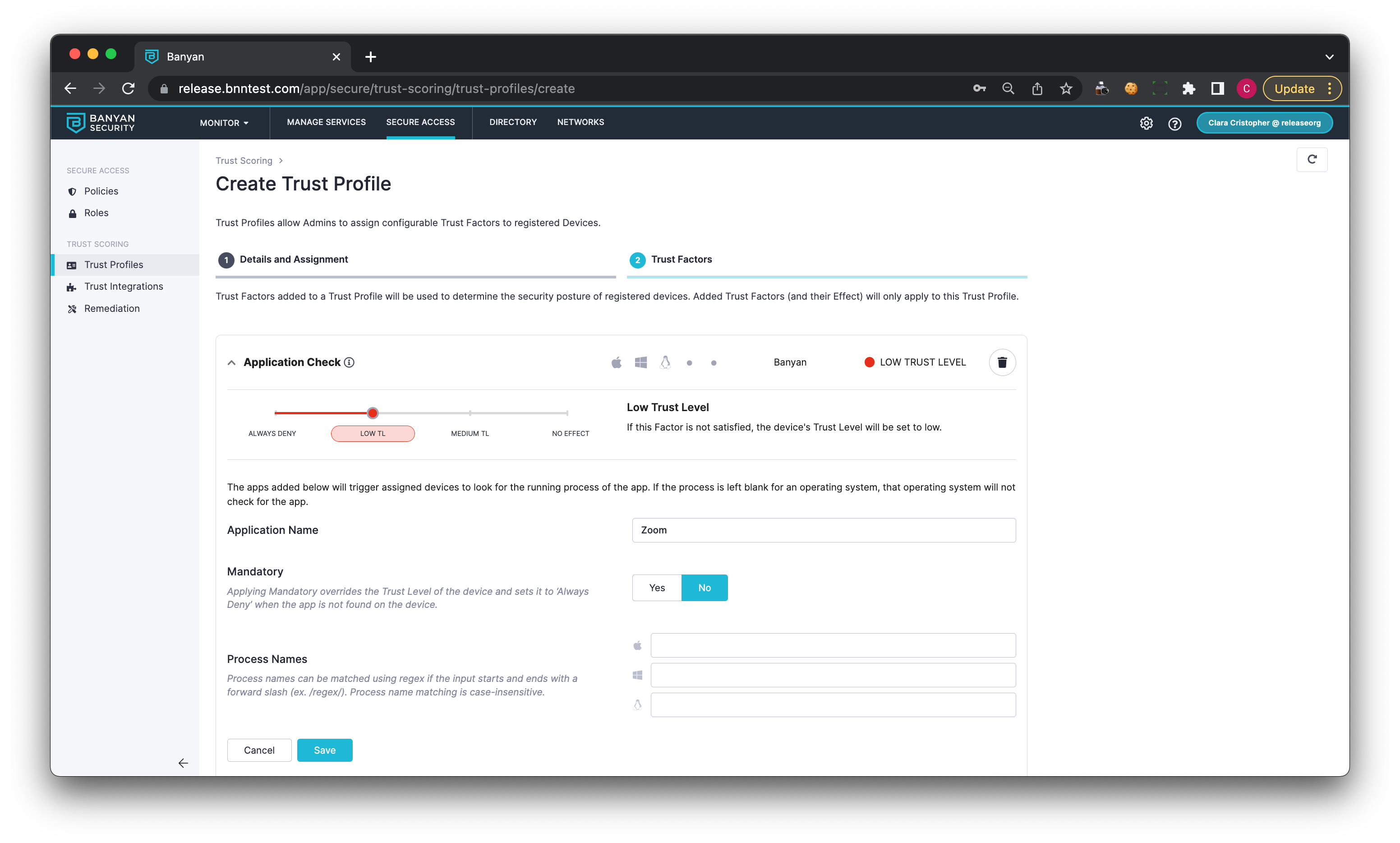
- Enter the Application Name (e.g.,
CrowdStrike Falcon). - Determine whether or not the app is Mandatory. If Yes, then the device Trust Level will be set to
Always Denyif the app is not running. If No, then device access will be allowed, but the device Trust Level will be reduced accordingly if the app is not running. - Enter the process name (one per platform) that should be running on a device (such as
falcond). See a list of common apps and their corresponding patterns below.
For apps that have variable process names, use regex pattern matching. For example, the Cisco Umbrella app has multiple process names depending on the app version running on a device, such as RoamingClientmenubar and umbrellamenu. In this scenario, you would enter /(umbrellamenu|RoamingClientmenubar)/ to match both process names accordingly.
4. Select Save.
Combining applications with OR and AND logic
Each application that you add to Application Check is a separate entry, with its own Application Name, Mandatory setting, and process name for each platform. Use the following rules to decide how many entries to create:
- OR (any one of several applications): Add a single entry. In the process name field for each platform, enter a regular expression that lists the accepted process names separated by a vertical bar (
|), and start and end the expression with a forward slash (/). The entry is satisfied when any one of the listed processes is running. - AND (all of several applications): Add a separate entry for each application. A device must have every listed application running to satisfy Application Check, and it does not receive partial credit for running only some of them.
You can combine both approaches in one Trust Profile: every entry must be satisfied, and an entry that uses a regular expression is satisfied by any one of its process names. The Mandatory setting applies to each entry separately, as described in Adding a mandatory application. If you leave the process name blank for a platform, devices on that platform do not check for that application.
Without the forward slashes, the input is not treated as a regular expression, so a vertical bar does not mean OR. Regular expressions in CSE are case-insensitive. For more information, see Using Regular Expressions in Cloud Secure Edge.
Example: Require any one of several security agents (OR)
To allow Windows devices that run either CrowdStrike Falcon or SentinelOne, add one entry:
- Application Name:
CrowdStrike Falcon or SentinelOne - Windows process name:
/(CSFalconService.exe|SentinelAgent.exe)/
A Windows device satisfies this entry when either CSFalconService.exe or SentinelAgent.exe is running. To apply the same rule on macOS or Linux, build the same kind of expression from the process names for that platform in Common Security Agent Process Names.
Example: Require all listed applications (AND)
To require that Windows devices run both Microsoft Defender Antivirus and the Huntress Agent, add two entries:
| Entry | Application Name | Windows process name |
|---|---|---|
| 1 | Microsoft Defender Antivirus |
MsMpEng.exe |
| 2 | Huntress Agent |
HuntressAgent.exe |
A Windows device satisfies Application Check only when both MsMpEng.exe and HuntressAgent.exe are running.
How Cloud Secure Edge Collects the Application Check Trust Factor
| OS | Command Input | Expected Output |
|---|---|---|
| macOS | ps -eco comm= |
TRUE |
| Windows | tasklist /fo csv /nh |
|
| Linux | ps -eo comm= |
Common Security Agent Process Names
When you add an application to Application Check, enter the process name for each platform exactly as shown in the table below, including the .exe extension on Windows. To accept any one of several products in a single entry, or to require several products, see Combining applications with OR and AND logic.
A dash (—) means that the product may not run on that platform, or that we do not know its process name for that platform. If you know that the product runs on that platform and you know its process name, let us know so that we can add it: under Was this page helpful? at the bottom of this page, select No, and then enter the product, the platform, and the process name.
Products built on the same engine share process names. For example, SentinelOne Singularity and each SentinelOne-based product in the table use sentineld on macOS and SentinelAgent.exe on Windows, so Application Check cannot distinguish between these products.
Note: The process names below are provided as a convenience. They reflect the names observed at the time of publication, and vendors can change them in product updates without notice. This information is not a warranty, and the inclusion of a product does not imply endorsement of, or partnership with, its vendor. Before you enforce a Trust Profile that depends on a process name, confirm that name on a test device by using the commands listed in How Cloud Secure Edge Collects the Application Check Trust Factor.
| App Name | Category | macOS | Windows | Linux |
|---|---|---|---|---|
| Acronis Cyber Protect Cloud | Backup and antivirus | — | cyber-protect-service.exe |
mms |
| Arctic Wolf Aurora Protect / Cylance | Antivirus and EDR | CylanceSvc |
CylanceSvc.exe |
cylancesvc |
| Bitdefender GravityZone / BEST | Antivirus and EDR | BDLDaemon |
EPSecurityService.exe |
bdsecd |
| Blackpoint Cyber SNAP | MDR response agent | — | SnapAgent.exe |
— |
| Carbon Black Cloud | EDR | repmgr |
RepMgr.exe |
cbagentd |
| Carbon Black EDR | EDR | CbOsxSensorService |
cb.exe |
cbdaemon |
| Cisco Umbrella | Internet gateway | /(umbrellamenu|RoamingClientmenubar)/ |
— | — |
| ConnectWise Managed EDR (SentinelOne) | EDR (SentinelOne-based) | sentineld |
SentinelAgent.exe |
— |
| CrowdStrike Falcon | EDR | com.crowdstrike.falcon.Agent |
CSFalconService.exe |
falcon-sensor |
| Cynet | EDR | — | — | CynetEPS |
| Datto EDR | EDR | agent.exe |
agent.exe |
agent.exe |
| Emsisoft protection service | Antivirus | ProtectionService |
a2service.exe |
— |
| ESET Inspect Connector | EDR component | — | EIConnector.exe |
— |
| Field Effect Endpoint Security Extension | Component of Field Effect MDR | covalence-esext |
— | — |
| Field Effect MDR / Covalence | EDR and MDR | covalence-endpoint |
covalence-endpoint.exe |
covalence-endpoint |
| Guardz EDR (SentinelOne) | EDR (SentinelOne-based) | sentineld |
SentinelAgent.exe |
s1-agent |
| Heimdal Antivirus | Antivirus | repClient |
Heimdal.Antivirus.exe |
— |
| Heimdal platform agent | Platform agent | Heimdal Agent |
Heimdal.ClientHost.exe |
— |
| Huntress Agent | MDR agent | HuntressAgent |
HuntressAgent.exe |
huntress-agent |
| Huntress EDR | EDR | com.huntress.sysext |
Rio.exe |
rio |
| Jamf Pro | MDM | JamfDaemon |
— | — |
| Jamf Protect | EDR | com.jamf.protect.security-extension |
— | — |
| Microsoft Defender Antivirus | Antivirus | wdavdaemon_unprivileged |
MsMpEng.exe |
wdavdaemon |
| Microsoft Defender for Endpoint | EDR | wdavdaemon_enterprise |
MsSense.exe |
wdavdaemon |
| N-able EDR (SentinelOne) | EDR (SentinelOne-based) | sentineld |
SentinelAgent.exe |
s1-agent |
| OpenText Core EDR / MDR | EDR and MDR | WSDaemon |
WRSA.exe |
— |
| RocketCyber / Kaseya MDR | SOC monitoring agent | — | rocketagent-x64.exe |
— |
| SentinelOne Singularity | EDR | sentineld |
SentinelAgent.exe |
s1-agent |
| SonicWall Capture Client | EDR (SentinelOne-based) | sentineld |
SentinelAgent.exe |
s1-agent |
| SonicWall Endpoint Security (SES) | EDR | — | TheronSVC.exe |
— |
| Sophos | Antivirus and EDR | SophosServiceManager |
SEDService.exe |
sophos_watchdog |
| Sophos LiveQuery | Component of Sophos EDR | — | SophosLiveQueryService.exe |
edr |
| Sophos Runtime Detections | Sophos component (Linux servers) | — | — | runtimedetections |
| ThreatDown / Malwarebytes | Antivirus and EDR | EndpointAgentDaemon |
MBCloudEA.exe |
mbdaemon |
| ThreatDown EDR plugin | Component of ThreatDown | com.malwarebytes.edr.helper.ext |
— | epa.linux.plugin.edr |
| ThreatLocker platform | Application allowlisting | ThreatLocker |
ThreatLockerService.exe |
— |
| Todyl Endpoint Security | EDR | — | sgnconnect.exe |
— |
| Trend Micro Vision One XDR Sensor | EDR and XDR | EDRAgent |
CloudEndpointService.exe |
vls_agent |
| Trend Micro Worry-Free | Antivirus | iCoreService |
NTRtScan.exe |
— |
| WatchGuard / Panda | Antivirus and EDR | AgentSvc |
PSANHost.exe |
AgentSvc |
| Webroot / OpenText Core Endpoint Protection | Antivirus | WSDaemon |
WRSA.exe |
— |
| WithSecure Elements EPP | Antivirus | wssensord |
fsulprothoster.exe |
— |